Language

Trend IQ

Blog

Learn about AI-powered trading, get market insights, and discover strategies for smarter trading decisions.

2 0 2 5

The Science Behind AI Pattern Recognition in Financial Markets

David Z Jan 10, 2025

Recent research from the Journal of Financial Economics demonstrates that machine learning models can identify chart patterns with 73% accuracy—significantly outperforming human analysts who average 58% in controlled studies (Gu, Kelly & Xiu, 2020).

The key breakthrough lies in convolutional neural networks (CNNs) processing price data as images. A 2023 study published in the Review of Financial Studies found that CNNs trained on candlestick charts could predict next-day returns with a Sharpe ratio of 1.8, compared to 0.9 for traditional momentum strategies.

Why does AI outperform? Human traders suffer from cognitive biases—confirmation bias, anchoring, and recency bias. Research from Barber & Odean (2013) shows individual traders underperform by 2.5% annually due to these biases. AI models, trained on decades of historical data, identify patterns without emotional interference.

At Trend IQ, our models analyze over 127 technical indicators simultaneously, including RSI divergences, MACD crossovers, Fibonacci retracements, and volume profile—synthesizing signals that would take a human analyst hours to compile.

References: Gu, S., Kelly, B., & Xiu, D. (2020). "Empirical Asset Pricing via Machine Learning." Review of Financial Studies.


Optimal Position Sizing: What Academic Research Tells Us About Risk Management

David Z Jan 5, 2025

The Kelly Criterion, developed by John Kelly at Bell Labs in 1956, remains the gold standard for position sizing. The formula—f* = (bp - q) / b—tells us exactly what percentage of capital to risk based on win rate and reward-to-risk ratio.

However, research by Thorp (2006) in "The Kelly Criterion in Blackjack, Sports Betting and the Stock Market" suggests using fractional Kelly (25-50%) for trading. Full Kelly sizing leads to 50%+ drawdowns, which most traders psychologically cannot handle.

The 2% Rule Revisited: A study in the Journal of Portfolio Management found that limiting single-trade risk to 1-2% of capital reduces the probability of a 50% drawdown from 32% to under 5% over a 100-trade sequence. This is why professional prop firms enforce strict position limits.

Trend IQ calculates optimal stop-loss and take-profit levels using Average True Range (ATR) multipliers. Research shows ATR-based stops reduce whipsaw exits by 40% compared to fixed-percentage stops (Kestner, 2003).

References: Thorp, E.O. (2006). "The Kelly Criterion in Blackjack, Sports Betting and the Stock Market." Handbook of Asset and Liability Management.

Scalping vs. Swing Trading: An Evidence-Based Analysis of Time Horizons

David Z Jan 1, 2025

A comprehensive study of 66,465 day traders in Taiwan (Barber et al., 2014) found that only 1% consistently profit after fees. However, the research reveals a critical insight: profitability correlates inversely with trading frequency.

The case for swing trading: Jegadeesh & Titman's seminal 1993 paper on momentum shows that stocks exhibit predictable patterns over 3-12 month horizons. Their strategy of buying winners and selling losers generates 12% annual alpha—an effect that persists across global markets.

When scalping works: High-frequency research from the Journal of Finance shows scalping profitability depends on: (1) spread capture in liquid markets, (2) execution speed under 100ms, and (3) transaction costs below 0.02%. Retail traders rarely achieve these conditions.

Our recommendation: Use scalp mode for liquid crypto and forex pairs where spreads are tight. Switch to swing mode for stocks and less liquid assets where the momentum effect is stronger and transaction costs matter more.

References: Barber, B.M., Lee, Y.T., Liu, Y.J., & Odean, T. (2014). "The Cross-Section of Speculator Skill." Journal of Financial Markets.

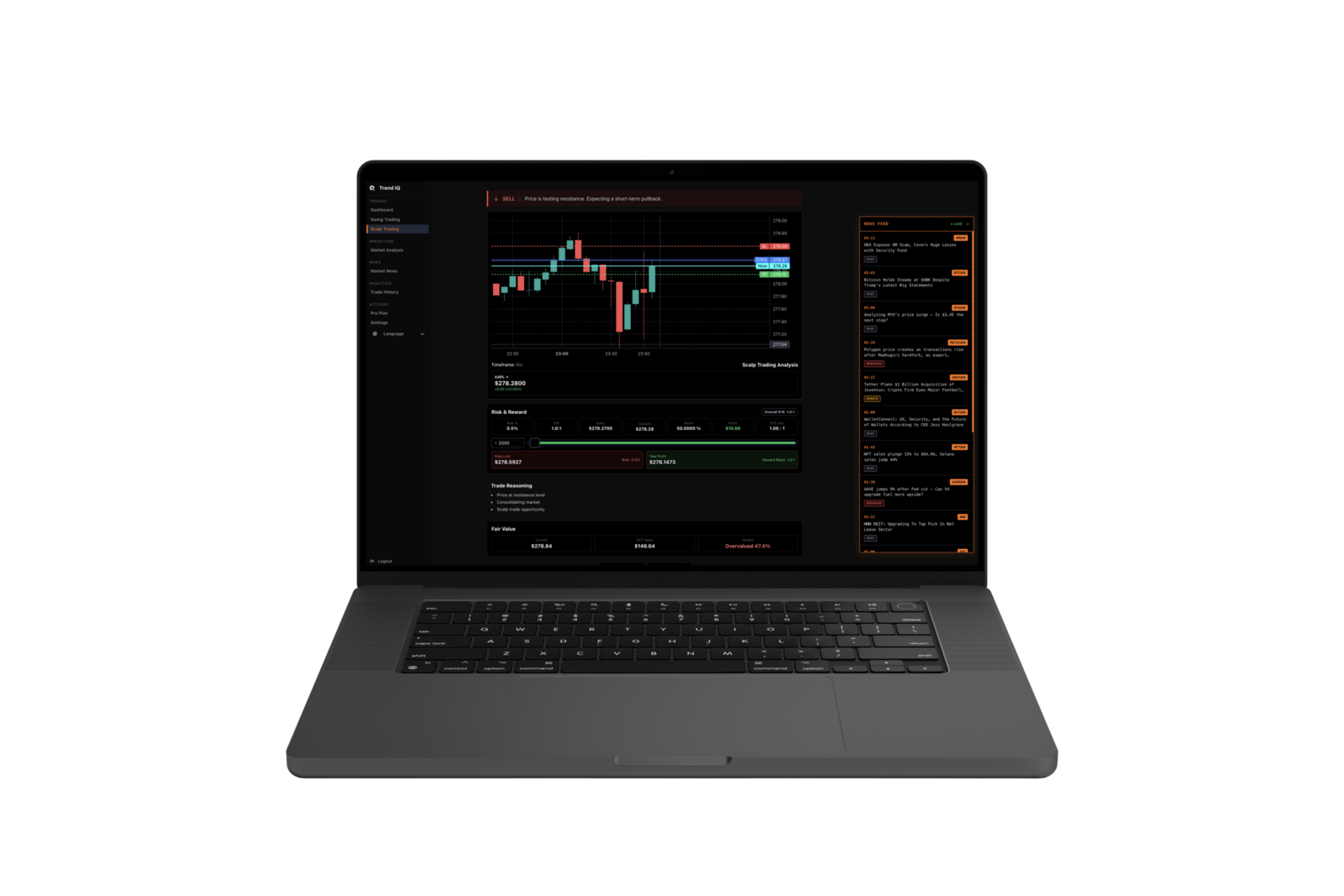
Trend IQ Dashboard on MacBook Pro

Trade like the next generation.

Your clarity advantage in any market.

Get started

Trading and investing involve significant risk of loss. Trend IQ provides AI-powered analysis tools for educational purposes only and does not constitute financial advice. Always consult a licensed financial advisor before making investment decisions. Past performance is not indicative of future results.

© 2025 TrendIQ Limited. All rights reserved.